Foundry is the owner's representative for NetSuite, Dynamics, SAP and POS programs.
Your systems integrator builds and configures. We run your side of the table:
the plan, the decisions, the data, the testing, and the go-live call.
$240Kin disputed change orders clawed back on one rescue
50+transformation projects across the team
Why client-sideThe other side is fully staffed
The incentive problem nobody prices in.
An ERP program has two sides. The integrator's side is fully staffed: an engagement
lead, solution architects, a bench of consultants, their own PMO. The client's side
is usually one IT director doing this for the first time, on top of a day job.
That gap has a price. Every week of drift is billable. Every scope gap comes back
as a change order, priced once you can no longer walk away. Status gets written by
the people being measured. None of this makes your integrator dishonest. It makes
them the other side of a commercial relationship.
The numbers are public: Panorama's annual survey puts
42% of programs over their timeline, and Rand Group prices the
recovery of a failed implementation at 150 to 200% of the original budget.
Someone who has run this playbook dozens of times has to sit on your side. That is the whole firm.
WorkAnonymized. References on request.
Four programs, four different jobs.
Every engagement below was run from the client's side of the table. Full write-ups
behind each card: what we walked into, what we did, what it measured.
Before you sign the SOW, or the moment something feels off in a live program.
What you get
A re-baselined plan, your contract reviewed against our 18 commercial red flags,
a risk report with owners and aging, and a week-by-week map of the next 90 days.
Written, and yours to keep either way. The fee credits toward a retainer if we continue.
Program management, kickoff to live
Monthly retainer · scoped to the program
When
You are about to start an implementation, or just did, and the client side of the table is thin.
What you get
We run your side end to end: governance and the decision log, the data workstream,
UAT built from your real transactions, cutover rehearsal, and a hypercare exit gate.
Mid-flight takeover
Starts with the Health Check
When
Milestones slipping, budget past plan with no re-baseline, and trust with the integrator thinning.
What you get
An independent read of where the program actually is, then we take the wheel on
your side: reset the plan, force the aged decisions, hold the gates. Recovery is
cheaper the earlier it starts, and we will tell you if a clean pause is the right call.
If ERP program management is a permanent, multi-phase need for your company, you
should hire, not retain us. Our own calculator says so, and we will too.
MethodThe same discipline on every program
The discipline, week by week.
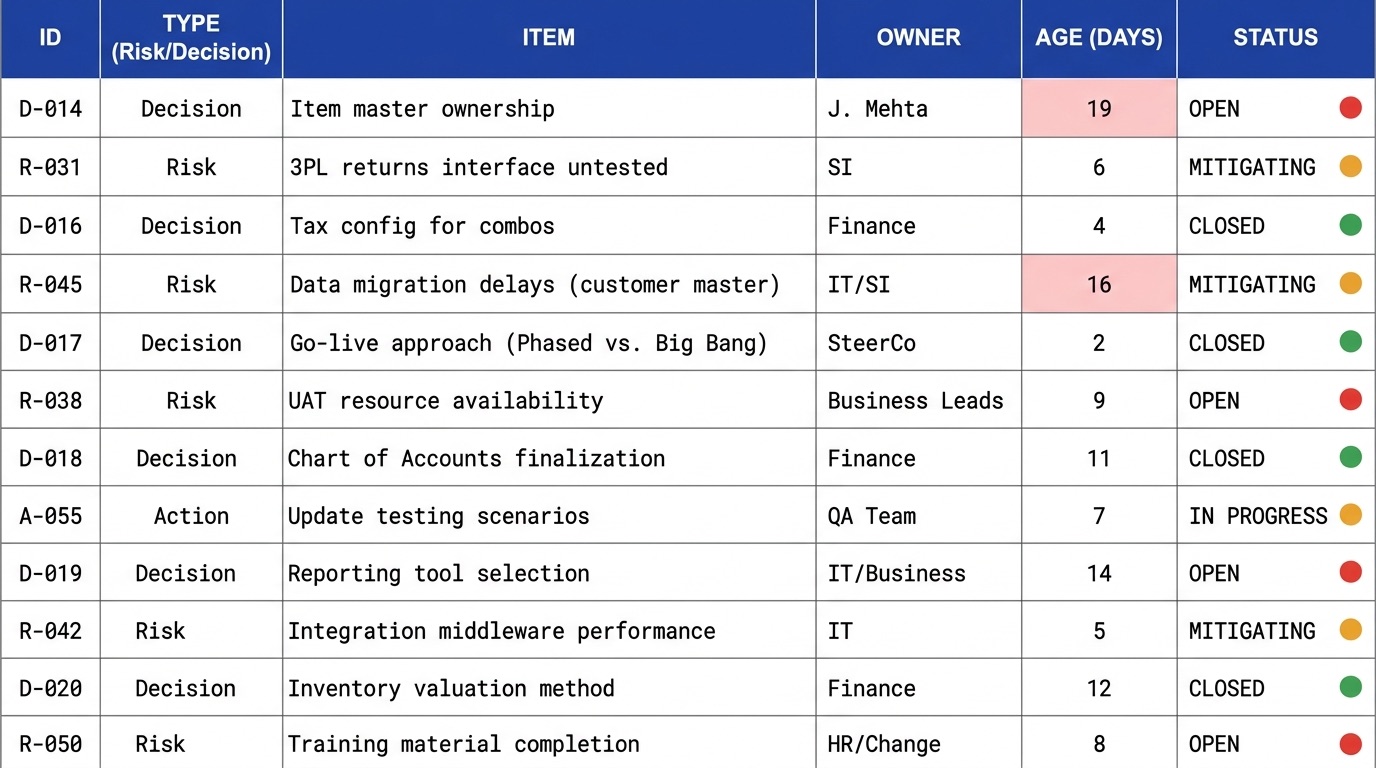
One decision log, jointly maintained. Every open item carries its
age in days. Anything older than fourteen days gets named in the weekly, with the
person it is waiting on.
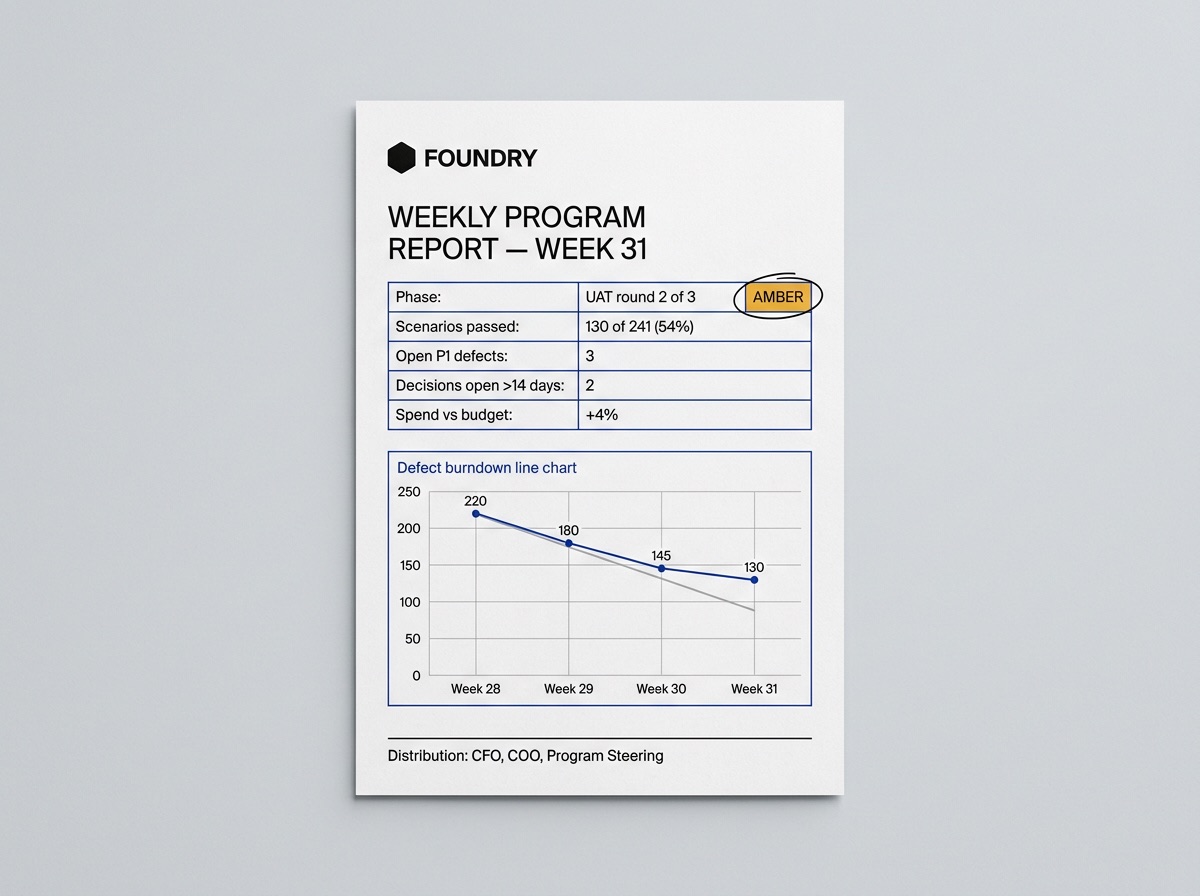
A one-page weekly, written by us. Plan versus actual, spend versus
budget, top three risks with owners. Not the vendor's deck about the vendor's work.
Exit gates between phases. Design closes when the gate criteria
pass, in writing, whatever the calendar says.
UAT from your ugliest real transactions. Returns against closed
periods, negative inventory, the order your team says the old system handled
weirdly. If round one passes above 95%, the scenarios were too easy.
Cutover rehearsed twice, rollback included. The go-live call is
made against written criteria.
Hypercare with exit criteria, not an end date. Week-three problems
should not arrive at new hourly rates.
Exhibit 1The weekly one-pager. Representative week 31.Exhibit 2The decision log. Age in days, named owners.
ToolkitFree. No form.
We publish our working tools.
These are the spreadsheets and checklists we run programs with, formulas included.
If you never hire us, use them anyway.
SOW Red-Flag Scorecard
XLSX · 18 clauses
Eighteen contract clauses that cost money later, as a scored sheet with a verdict. Run your draft SOW through it before signature.
A budget model with the lines the quote leaves out: backfill, data cleanup, contingency. Plus hire-versus-firm with the empty-seat months priced in. It recommends hiring when hiring wins.
Forty pre-written scenarios that break implementations, with a defect log and pass-rate math. If your integrator's test plan looks nothing like it, that is finding number one.
The sheets open view-only. To work in one, use File → Make a copy
and it is yours. Or email
anmol@foundryme.com
and we send the full pack.
FirmFounder-led
Who does the work.
Foundry is led by Anmol Agarwal. Ex-Bain. Behind her, a team that
has run 50+ transformation projects across ERP, finance systems, and operations.
The delivery bench is senior ERP operators, not analysts learning on your budget.
Founder-led: the person you meet is the person in your steering meeting. We keep
the roster small enough for that to stay true, and we take no software commissions
and no referral fees from integrators. The only side we are paid by is yours.